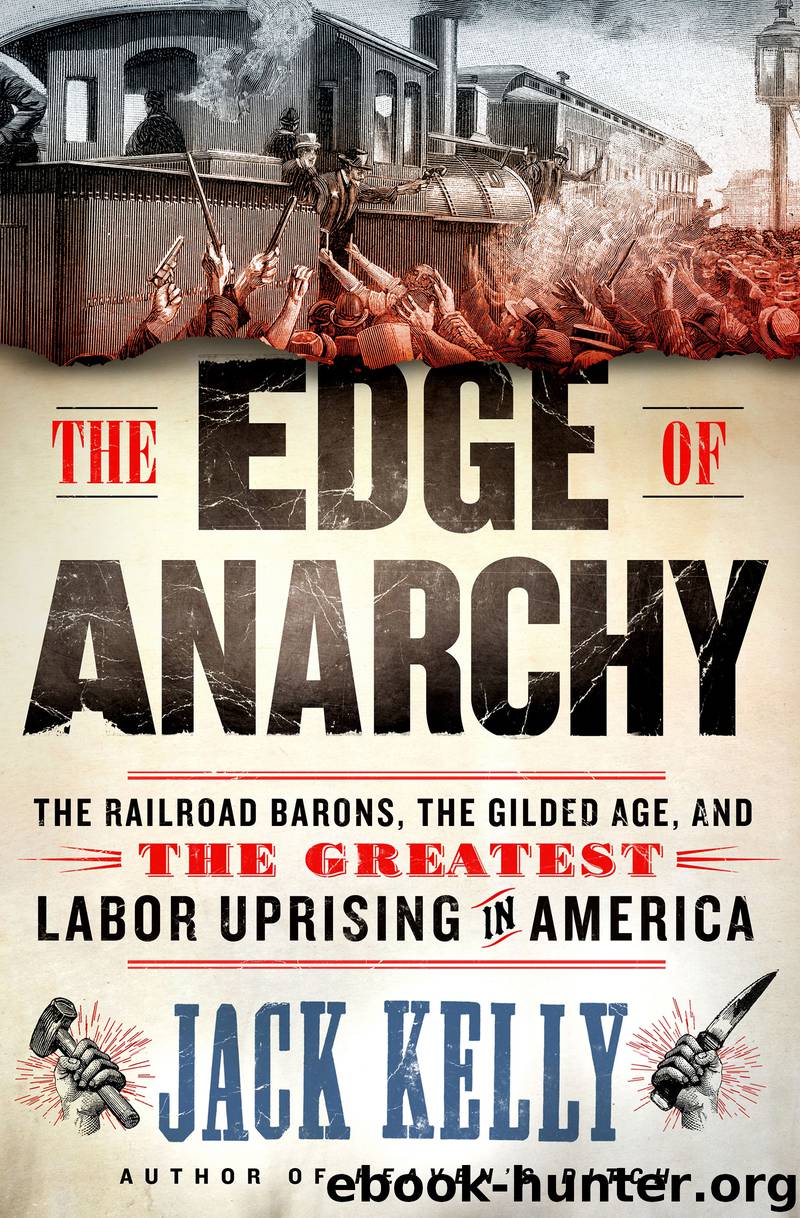
The Edge of Anarchy by Jack Kelly
Author:Jack Kelly
Language: eng
Format: epub
Publisher: St. Martin's Press
PART III
July 4–July 12, 1894
17
We Shall Have Debs
Independence Day. A cloudless sky stretched over Chicago and temperatures were expected to top out in the seventies. Perfect weather for picnics.
Eugene Debs awoke early. From his hotel window, he saw the morning star wink out over the lake and heard the distant bang of torpedoes and firecrackers set off by young patriots eager to commence the holiday celebration. And something else: a commotion in the hotel’s courtyard. He glanced down. Soldiers. Men in khaki were stacking their rifles. He called excitedly to his brother. These were not militiamen. “They’re regulars, Theodore, they’re regulars. Do you get that? Cleveland has sent the troops in.”
Debs had known that the deployment was a possibility, but the sight of the soldiers struck him with a jolt. Excited, anxious, and confused, he instinctively reached for a hopeful slant on the development. Federal troops, he imagined, would tamp down the growing disorder. They were not a threat to the ARU. They could not operate trains and would not molest lawful strikers. They would prevent rioters from “destroying property, the stigma of which is placed by capital on labor,” he said.
In his heart, he knew he was wrong. The appearance of federal soldiers marching through an American city was not a good omen for the outcome of the strike.
That Wednesday, July 4, marked a change in the trajectory of the crisis, but at first no one knew the direction events would take. Workers accustomed to long hours and six-day weeks relished the luxury of a day off. All citizens welcomed the brief pause from the tension of the nationwide boycott.
Chicago’s business district was deserted. Even the bustling ARU headquarters at Ulrich’s Hall was quiet that day. Debs had directed union members to stay away from rail depots and yards. All day, he and the other officers roamed the city addressing public meetings, encouraging the strikers, warning against violence.
Paraders strutted through Chicago’s streets to the robust beat of John Philip Sousa tunes. Politicians and clergymen intoned patriotic platitudes. Picnickers thronged the city’s parks. At night, bonfires blazed in residential neighborhoods, accompanied by the bang and sparkle of fireworks. Intoxicated crowds made merry in saloons until closing time. Citizens across the city wore the white ribbons that showed their support of the strikers.
The nation had stopped to acknowledge the 118th anniversary of the Declaration of Independence. Men and women were still alive whose grandfathers had fought alongside George Washington. Many were prompted to reflect on the questions the current impasse between labor and capital had raised about the country’s founding principles.
Eugene Debs and George Pullman personified two views as to the proper course for the Republic. Citizens revered the sanctity of property, but Debs would wrench control of the railroads from private investors if they did not bend to the needs of employees. Americans also clung to the notion that a workingman should receive fair pay for a day’s labor, but Pullman would run his business as he saw fit, even if his men were forced to work for starvation wages.
Download
This site does not store any files on its server. We only index and link to content provided by other sites. Please contact the content providers to delete copyright contents if any and email us, we'll remove relevant links or contents immediately.
| Anthropology | Archaeology |
| Philosophy | Politics & Government |
| Social Sciences | Sociology |
| Women's Studies |
The Secret History by Donna Tartt(19097)
The Social Justice Warrior Handbook by Lisa De Pasquale(12193)
Thirteen Reasons Why by Jay Asher(8915)
This Is How You Lose Her by Junot Diaz(6891)
Weapons of Math Destruction by Cathy O'Neil(6283)
Zero to One by Peter Thiel(5805)
Beartown by Fredrik Backman(5763)
The Myth of the Strong Leader by Archie Brown(5511)
The Fire Next Time by James Baldwin(5452)
How Democracies Die by Steven Levitsky & Daniel Ziblatt(5221)
Promise Me, Dad by Joe Biden(5155)
Stone's Rules by Roger Stone(5089)
A Higher Loyalty: Truth, Lies, and Leadership by James Comey(4965)
100 Deadly Skills by Clint Emerson(4929)
Rise and Kill First by Ronen Bergman(4792)
Secrecy World by Jake Bernstein(4755)
The David Icke Guide to the Global Conspiracy (and how to end it) by David Icke(4721)
The Farm by Tom Rob Smith(4516)
The Doomsday Machine by Daniel Ellsberg(4492)
